
Tue, April 10, 2017
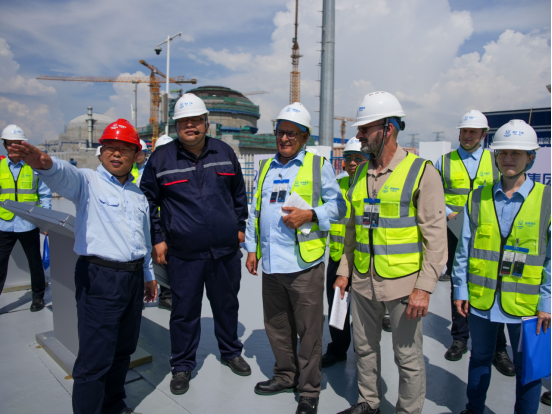
The IPPAS team visited the Hainan Changjinang Linglong One Small Modular Reactor. (Credit: Hainan Nuclear Power Company)
An International Atomic Energy Agency (IAEA) team of experts has concluded a twelve-day International Physical Protection Advisory Service (IPPAS) follow-up mission in the People’s Republic of China. Building on an initial IPPAS mission conducted in 2017, it was the first ever IPPAS mission to include the review of the physical protection of a small modular reactor (SMR).
Held from 29 June to 10 July, the mission was carried out at the request of the Government of China and hosted by the China Atomic Energy Authority (CAEA) and its technical support organization, the State Nuclear Security Technology Center (SNSTC).
The scope of the mission included a review of China's legislative and regulatory framework for nuclear security, the physical protection of nuclear material and nuclear facilities, and progress in implementing recommendations and suggestions from the 2017 IPPAS mission. As part of the mission, the IPPAS team visited the Hainan Changjinang Linglong One SMR site – the world's first commercial SMR on land – as well as the Qinshan Nuclear Power Base Fangjiashan Nuclear Power Plant (NPP).
The team identified significant progress in addressing the findings of the 2017 IPPAS mission and observed improvements in China’s nuclear security regime and in physical protection at Qinshan NPP. The team also concluded that physical protection arrangements at the Hainan Changjinang Linglong One SMR have followed the IAEA nuclear security guidance.
The eight-person review team, led by Khammar Mrabit, a former Director General of the Moroccan Agency for Nuclear and Radiological Safety and Security and member of the Moroccan Parliament, included experts from Finland, France, the Kingdom of the Netherlands, Pakistan, the Russian Federation, and the United Kingdom, as well as one IAEA staff member.
The team held discussions with CAEA, SNSTC, the Ministry of Foreign Affairs, the Public Security Bureau of the Ministry of Public Security, the National Nuclear Safety Administration, the China National Nuclear Corporation, and other organizations involved in national nuclear security.
“The follow-up IPPAS mission in China confirmed the country’s significant advances in strengthening nuclear security and identified several good practices,” said Karine Herviou, IAEA Deputy Director General and Head of the Department of Nuclear Safety and Security, during the mission’s closing ceremony. “The mission marked a milestone as the first IPPAS mission to include within its scope a review of the physical protection systems and measures at an SMR site.”
The team also noted the rapid expansion of China's nuclear energy programme requires consideration of human resources needs for nuclear security in the CAEA and SNSTC.
“China attaches great importance to this IPPAS follow-up mission,” said Li Ziping, Director-General of CAEA’s Department of System Engineering. “China will carefully consider the recommendations made by the IPPAS team and implement them, as appropriate, with a view to further strengthening its governmental regulatory oversight of nuclear security and continuously enhancing nuclear security. China remains firmly committed to international cooperation on nuclear security and stands ready to actively participate in global nuclear security governance. It will continue to make its contribution to promoting a fair, cooperative and mutually beneficial international nuclear security framework, so that all States can share the benefits of the peaceful uses of nuclear energy.”
Background
The mission was the 111th IPPAS mission conducted by the IAEA since the programme began in 1995 and the first review of an SMR’s physical protection arrangements.
IPPAS missions are intended to assist States in strengthening their national nuclear security regime. The missions provide peer advice on implementing international instruments, along with IAEA guidance on the protection of nuclear and other radioactive material and associated facilities.
During missions, a team of international experts observes a nation's system of physical protection, compares it with international good practices and makes recommendations for improvement. IPPAS missions are conducted both on a nationwide and facility-specific basis.